Home / PDS
Pulsation dampening disc PDS
Efficient damping of gas pulsations in reciprocating compressors.
Gas pulsations from reciprocating compressors can stress pipes, fittings and connected components, cause noise and vibration and impair operational reliability.
The pulsation dampening disc (PDS) offers a simple, compact and economically attractive solution.
Static, simple and maintenance-free
The PDS is a fixed (static) component for reducing pulsation. Unlike conventional bladder or diaphragm pulsation dampers, it works entirely without moving parts and without a gas cushion.
The PDS is installed in the pipe between two flanges. A specially designed arrangement of bores reduces the pulsation amplitudes specifically in the relevant frequency range.

Operating principle: reflection and dissipation
The PDS specifically influences how pressure waves propagate in the pipe. Reflection reduces unfavourable standing waves and resonance effects. At the same time, part of the pulsation energy is converted into heat by flow resistance and friction (dissipation).
This reduces the pulsation energy in a targeted way – without moving parts or a gas cushion.
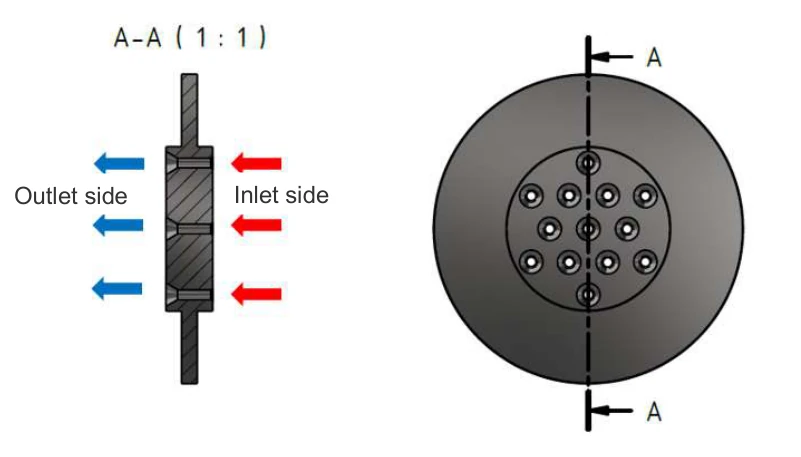
Designed individually – not a broadband damper
The PDS is not a broadband damper. It is designed optimally for a defined operating point and the pulsation frequencies that occur there.
That is why volume flow, pressure, temperature, pulsation frequency, piping geometry and installation situation, among other things, are taken into account.
Important: If the operating conditions change significantly – for example volume flow or pressure – the damping effect may deteriorate accordingly. Optimal performance therefore requires a design that is defined as precisely as possible for the intended operating range.
Example: damping the discharge pulsation
- Compressor
- reciprocating, oil-free, single cylinder
- Speed
- n = 1,450 min−1
- Discharge frequency
- f = 24 Hz (period T = 41.67 ms)
- Volume flow
- 2,000 l/min
- Operating gauge pressure
- p = 10 bar
Pressure curve upstream and downstream of the pulsation dampening disc (PDS)
The rule is: not as much damping as possible – but as much as necessary.
Your advantages
- Simple – compact installation between existing flanges
- Maintenance-free – no moving parts, no gas cushion, no absorption material
- Efficient – targeted damping with low pressure loss
- Flexible – material and design adaptable to the application
- Economical – compact alternative or addition to more elaborate damping measures
Our solution for your application
The PDS is not an off-the-shelf standard component. Its optimal effect results from the individual design and the right position in the piping system.
You give us your operating data – we assess the application and develop the matching pulsation dampening disc.